Solar CRM: Close More Deals with Smart Follow-Ups
The Spreadsheet Problem
Most solar installers start the same way: a WhatsApp group for leads, a shared Google Sheet for tracking, and a folder of PDF quotes emailed manually. It works — until it doesn’t.
As your team grows past two salespeople, the cracks appear fast. Leads fall through because nobody remembers who followed up last. A quote goes out and sits unanswered for ten days while your competitor calls the same homeowner twice. Your best salesperson leaves and takes the customer context with them because it lived in their head, not in a system.
Spreadsheets are static. Solar sales is not. Every lead is in a different stage, needs a different follow-up, and has a different objection to handle. A spreadsheet cannot remind you, cannot send a WhatsApp message, and cannot show you your pipeline at a glance.
The Solar Sales Pipeline
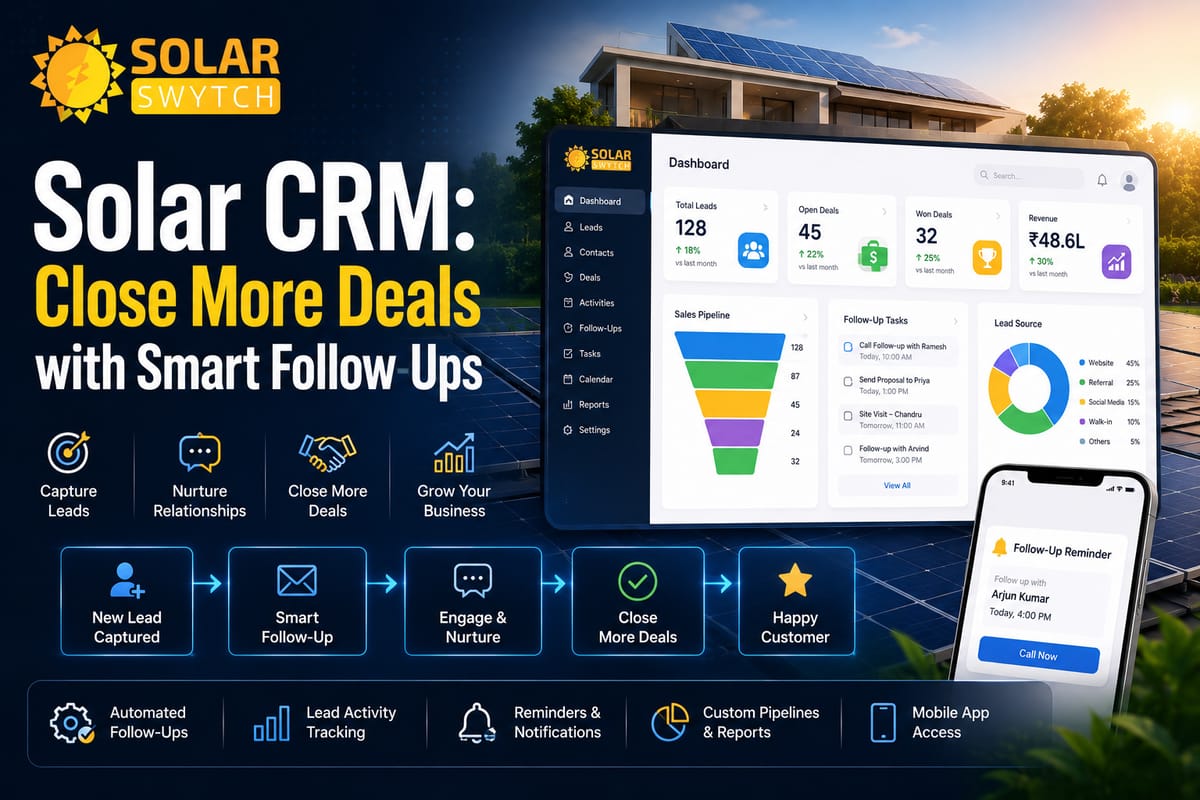
A solar CRM structures your sales into clear, trackable stages. A typical pipeline for a residential installer looks like this:
- Lead Captured — Inquiry received from website, referral, or campaign.
- Contacted — Initial call or WhatsApp message sent; interest confirmed.
- Site Survey Scheduled — Visit booked; roof assessment and shadow analysis pending.
- Quote Sent — Proposal delivered with system size, subsidy breakdown, and ROI.
- Negotiation — Customer has questions, wants a revised size or price.
- Won — Agreement signed, advance payment received.
- Installation — Work order raised, team dispatched, progress tracked.
- Completed — Net meter installed, subsidy application filed, review requested.
When every lead is visually placed on this board, your sales manager can see in thirty seconds which deals are stalling, who needs a nudge, and where your team’s time is going.
Speed-to-Lead Is Everything
Research across industries consistently shows that the first vendor to respond wins the deal more than 50% of the time. In solar, where a homeowner might enquire with three or four installers simultaneously, response speed is a direct competitive advantage.
A CRM with automated lead capture pulls enquiries from your website form, Facebook lead ads, or Google campaigns directly into the pipeline — and triggers an instant acknowledgement message to the customer. No manual copy-paste, no delay while someone checks their inbox.
When your team opens their morning dashboard, every new lead is already sitting in “Lead Captured” waiting for a call, not buried in an email thread.
WhatsApp Follow-Ups That Actually Get Read
Email open rates for small businesses hover around 20-25%. WhatsApp message open rates are consistently above 90%. For Indian customers, WhatsApp is not a marketing channel — it is the primary communication channel.
A solar CRM with built-in WhatsApp integration lets your team:
- Send quote reminders automatically after 48 hours of no response.
- Share the proposal PDF directly in the chat without switching apps.
- Receive customer replies inside the CRM so nothing is missed.
- Schedule follow-up messages for a specific day (e.g., after a festival when customers are ready to decide).
The result is a follow-up cadence that runs in the background without your team having to remember each individual lead.
Measuring What Actually Converts
One of the biggest advantages of a CRM over a spreadsheet is conversion visibility. You can answer questions like:
- What percentage of site surveys turn into won deals?
- Which lead source (referral, Google, Facebook) closes at the highest rate?
- How many touches does an average deal need before signing?
- Which salesperson has the best quote-to-close ratio?
These numbers tell you where to invest — whether that is in more survey capacity, a better proposal template, or additional follow-up training.
Your Solar CRM Readiness Checklist
Before evaluating any CRM, confirm it can do the following for a solar business:
- Capture leads automatically from web forms and ad platforms
- Show a visual Kanban pipeline with custom solar-specific stages
- Generate and send proposals with subsidy calculations from inside the CRM
- Send and receive WhatsApp messages without switching to a separate app
- Remind salespeople to follow up after a set number of days
- Report lead source, stage conversion rates, and team performance
- Work on mobile so field teams can update deal status on-site
A generic CRM will cover the basics. A solar-specific CRM will speak your language — kW, subsidy slabs, DISCOM, net metering — without requiring you to customise every field from scratch.
SolarSwytch is built specifically for Indian solar installers, with all of the above included out of the box. If you are ready to move beyond the spreadsheet, your pipeline will thank you within the first week.
Join the conversation. Comments are coming soon — check back shortly.