West Bengal Solar Subsidy 2026: Amounts & How to Claim
Rooftop solar is becoming the favourite way for Indian households to cut electricity bills and reduce carbon footprints. In West Bengal, the central PM Surya Ghar Muft Bijli Yojana offers a generous cash incentive that can cover a large part of the upfront cost. This article explains everything you need to know about the solar subsidy west bengal scheme, from eligibility rules to the exact amount you can claim, and how to complete the online application without a hitch. Whether you are a first‑time buyer or already own a small system, the step‑by‑step guide will help you maximise the benefit and avoid common pitfalls.
The central subsidy works alongside state‑specific top‑ups, which vary from one DISCOM to another. While the exact state amount is not fixed in the national policy, you can check the latest figures on your local DISCOM website or the state portal linked in the application process. The central component, however, is clear and uniform across the country: a flat ₹30,000 per kW for the first 2 kW and an additional ₹18,000 per kW for the next 1 kW, capping the total at ₹78,000 for systems of 3 kW and above. This can translate into a substantial reduction in the capital required for a 3 kW rooftop system, which is the most common size for a typical Indian home.
To claim the subsidy, you must go through the official portal pmsuryaghar.gov.in, where your DISCOM will verify the feasibility of your roof, approve the net‑metering agreement, and finally release the funds directly to your bank account. The process replaces the old paperwork‑heavy method with a streamlined digital workflow, but it still requires careful preparation of documents such as proof of roof ownership, a valid electricity connection, and a declaration that you have not received any prior solar subsidy. By following the roadmap laid out in this guide, you can complete the entire journey—from registration to installation—within a few weeks.
Beyond the cash incentive, installing solar also brings long‑term savings. A 3 kW system can generate roughly 300 kWh per month, which can offset up to 300 units of electricity—exactly the free electricity limit announced for 1 crore households under the scheme. With the subsidy reducing the upfront cost, the payback period often drops to 3–4 years, after which the electricity is essentially free for the life of the system (typically 25 years). This makes the solar subsidy west bengal not just a short‑term grant but a catalyst for a financially sound, environmentally friendly home.
In the sections that follow, we will break down the key facts, walk you through the application steps, and show you the cost‑benefit calculations you need to make an informed decision. Let’s get started!
Quick Answer: Eligible West Bengal homeowners can claim up to ₹78,000 per rooftop system under PM Surya Ghar Muft Bijli Yojana by applying at pmsuryaghar.gov.in.
Key Facts
- Central subsidy of ₹30,000 per kW for the first 2 kW of capacity. pmsuryaghar.gov.in
- Additional ₹18,000 per kW for capacity between 2 kW and 3 kW, capping the total at ₹78,000. pmsuryaghar.gov.in
- Scheme targets 1 crore households with up to 300 kWh free electricity per month. PIB, Feb 2024
- Application must be made online at pmsuryaghar.gov.in with DISCOM verification. pmsuryaghar.gov.in
- Subsidy is only for residential grid‑connected rooftop systems; commercial installations are excluded. pmsuryaghar.gov.in
Table of Contents
- Why Solar Subsidy West Bengal Matters
- Common Misconceptions
- Solar Subsidy West Bengal — How It Works & What You Must Know
- Solar Subsidy West Bengal — Costs, Savings and Returns
- Real‑World Use Cases and Scenarios
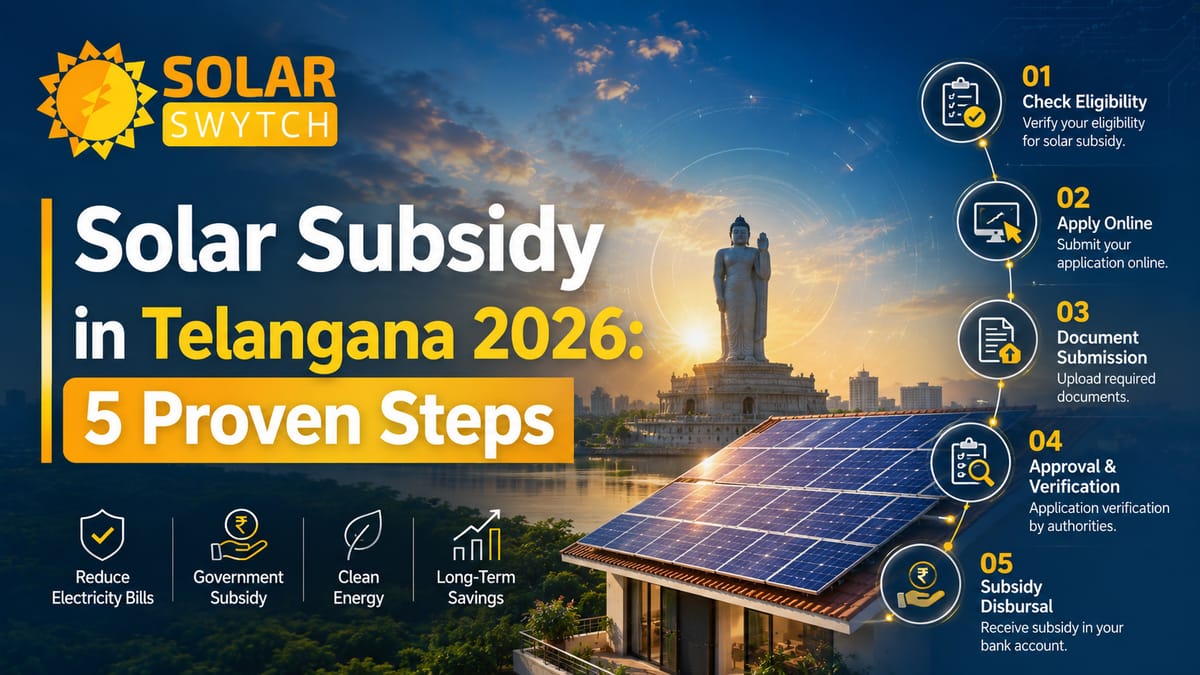
- Solar Subsidy West Bengal – Step‑by‑Step Roadmap
- Illustrative Example
- Solar Subsidy West Bengal – Alternatives and Comparison
- Solar Subsidy West Bengal — Rules, Compliance and Regulations
- Frequently Asked Questions
- Conclusion
Why Solar Subsidy West Bengal Matters
The Indian government has taken a bold step to make clean electricity affordable for every home. The PM Surya Ghar Muft Bijli Yojana offers a central cash‑in‑hand (CFA) subsidy of Rs 30,000 per kW for the first 2 kW and an additional Rs 18,000 per kW for capacity between 2 kW and 3 kW. For systems of 3 kW and above the total central subsidy is capped at Rs 78,000. This generous support, combined with state‑level top‑ups that differ from one DISCOM to another, can reduce the upfront cost of a rooftop solar system by up to 40 % in many parts of West Bengal.
The scale of the opportunity
| Parameter | Central Scheme (PM Surya Ghar Muft Bijli Yojana) | Typical State Top‑Up (West Bengal) | Total Possible Support |
|---|---|---|---|
| Subsidy per kW (0‑2 kW) | Rs 30,000 | Varies – check your DISCOM portal | Up to Rs 30,000 + state amount |
| Subsidy per kW (2‑3 kW) | Rs 48,000 (30,000 + 18,000) | Varies | Up to Rs 48,000 + state amount |
| Subsidy cap for ≥3 kW | Rs 78,000 | Varies | Up to Rs 78,000 + state amount |
| Target households | 1 crore (≈300 kWh free per month) | – | – |
| Eligible system type | Residential grid‑connected rooftop only | – | – |
The table shows that the central subsidy is the same across India, but the total amount a homeowner can receive depends heavily on the state top‑up. In West Bengal, the DISCOMs (e.g., WBSEDCL, CESC) publish their own additional amounts on their websites. Because these figures change with budget allocations, we recommend checking the latest DISCOM announcement before preparing your proposal.
How the subsidy changes the economics
Consider a 3 kW rooftop system that costs Rs 1,20,000 per kW (including panels, inverter, mounting and installation). The total system price would be Rs 3,60,000. With the central subsidy capped at Rs 78,000, the out‑of‑pocket cost drops to Rs 2,82,000. If the West Bengal DISCOM adds a top‑up of Rs 20,000 per kW, the homeowner receives an extra Rs 60,000, further reducing the payment to Rs 2,22,000 – a saving of more than 38 %.
Such a reduction shortens the payback period from the typical 5‑6 years to around 3‑4 years, making solar a financially sound choice even before accounting for the free electricity promised under the scheme (up to 300 kWh per month).
Why West Bengal is a hot spot
West Bengal enjoys a fairly high solar irradiance of 4.2 kWh/m²/day on average, especially in the districts of Kolkata, Hooghly, and North 24 Parganas. The state’s flat rooftops, dense housing, and growing middle‑class population create a massive market for residential solar. Moreover, the state government has been proactive in promoting renewable energy, aligning its policies with the central PM Surya Ghar Muft Bijli Yojana.
For installers, the combined central and state subsidies simplify the sales pitch: a clear, cash‑back amount can be shown to the homeowner at the proposal stage. The process involves:
- Online registration on the national portal pmsuryaghar.gov.in.
- DISCOM feasibility approval – the local utility checks roof suitability and net‑metering capacity.
- Installation by a vendor registered under the scheme.
- Net‑metering agreement – required before the subsidy is released.
- Final inspection and subsidy credit to the homeowner’s bank account.
Each step is transparent, and the portal allows applicants to track the status of their claim. For a quick guide on checking your application, see the article PM Surya Ghar Application Status: How to Track Your Subsidy.
The broader impact on the grid
By encouraging 1 crore households to install rooftop solar, the scheme aims to reduce the load on the central grid by an estimated 30‑35 GW of distributed generation. In West Bengal, this could translate to a reduction of ≈2 GW of peak demand, easing pressure on aging thermal plants and lowering greenhouse‑gas emissions. Homeowners also benefit from energy independence; during a grid outage, a well‑designed solar‑plus‑battery system can keep essential appliances running, though batteries are not part of the subsidy.
Challenges that need attention
While the monetary benefit is clear, many households still hesitate because of:
- Lack of awareness – many do not know the exact subsidy amount or the online application steps.
- Documentation hurdles – roof ownership proof, previous electricity bills, and identity documents must be uploaded correctly.
- Installation quality – without a reliable installer, the system may under‑perform, reducing the expected savings.
A software platform that automates proposal generation, incorporates the exact subsidy figures, and tracks each lead from WhatsApp enquiry to final inspection can bridge these gaps. Tools designed specifically for Indian installers help avoid spreadsheet errors and keep every stakeholder on the same page.
In summary, solar subsidy west bengal is more than a financial incentive; it is a catalyst for a cleaner, more resilient energy future. Homeowners who act now can lock in the maximum cash‑back, enjoy lower electricity bills, and contribute to the state’s renewable‑energy goals. The next step is simply to register on the official portal, get your DISCOM’s feasibility approval, and choose a reputable installer who can deliver a compliant, high‑quality system.
Common Misconceptions
Myth 1 – “The subsidy is only for large systems, not for my 1 kW rooftop.”
Reality: The central cash‑in‑hand subsidy starts at Rs 30,000 per kW for the first 2 kW. Even a 1 kW system qualifies, receiving Rs 30,000 directly in the homeowner’s bank account. The state top‑up, if any, is also applied per kW, so small systems still benefit proportionally.
Myth 2 – “I must buy panels from a government‑approved vendor to get the subsidy.”
Reality: The scheme does not prescribe a specific hardware brand. The only requirement is that the installer is registered under the PM Surya Ghar Muft Bijli Yojana and follows the net‑metering guidelines of the local DISCOM. Homeowners can choose any certified equipment, provided the installer submits the correct invoice.
Myth 3 – “The subsidy is a loan that I have to repay later.”
Reality: The cash‑in‑hand amount is a grant, not a loan. After the system is inspected and the net‑metering agreement is in place, the approved subsidy is credited directly to the homeowner’s bank account. There is no repayment schedule, interest, or hidden fees attached to the central portion.
Myth 4 – “State top‑ups are the same everywhere, so I don’t need to check my DISCOM.”
Reality: State‑level top‑ups differ by DISCOM and can change each financial year. West Bengal’s major DISCOMs publish their own additional amounts on their respective portals. Ignoring this step can mean missing out on an extra Rs 10,000‑Rs 25,000 per kW that could further lower your out‑of‑pocket cost. Always verify the latest figures on the DISCOM website before finalising your proposal.
Myth 5 – “Once I apply, the subsidy is guaranteed.”
Reality: The subsidy is contingent on several conditions: the roof must belong to the applicant, the system must be installed by a registered vendor, and the net‑metering agreement must be signed before the final inspection. If any of these steps are incomplete, the claim may be rejected or delayed. Keeping all documents up‑to‑date and working with a compliant installer reduces the risk of denial.
Myth 6 – “I can claim the subsidy for a second solar system after the first one is approved.”
Reality: The scheme allows one subsidy per residential connection. If a homeowner has already received the cash‑in‑hand amount for an existing rooftop system, a second claim for the same property is not permitted. However, if the first system is expanded (e.g., from 2 kW to 3 kW) and the additional capacity falls within the eligible range, the homeowner may apply for the incremental subsidy, subject to DISCOM approval.
Myth 7 – “The subsidy covers the entire cost of the system.”
Reality: Even with the maximum central subsidy of Rs 78,000 and a possible state top‑up, the homeowner still bears a portion of the system cost. For a typical 3 kW installation priced at Rs 3,60,000, the combined subsidies may cover ≈60 % of the total, leaving the balance to be financed or paid outright. This remaining amount can often be managed through easy‑EMI schemes offered by many installers.
Understanding these myths and the actual facts helps homeowners make an informed decision and avoid unnecessary delays. For a deeper dive into the exact subsidy numbers, refer to the guide PM Surya Ghar Subsidy Amount Explained: Rs.30,000/kW to Rs.78,000.
Solar Subsidy West Bengal — How It Works & What You Must Know
Installing rooftop solar in West Bengal has become much easier after the launch of the PM Surya Ghar Muft Bijli Yojana. Below is a detailed, step‑by‑step explanation of the entire process, supported by official data and practical tips.
1. Who Can Apply?
- Residential households only – you must own the roof and have a valid electricity connection.
- No prior solar subsidy – the scheme is a one‑time benefit per household.
- Ownership rights – you should be able to prove legal ownership or long‑term lease of the roof.
These criteria are enforced during the DISCOM feasibility check. If you have rented accommodation, you can still apply only if the landlord provides a written consent and the roof is under your control for the system’s lifetime.
2. System Size and Subsidy Calculation
The central subsidy follows a tiered structure:
| System Capacity | Central Subsidy per kW | Total Central Subsidy |
|---|---|---|
| 1 kW | ₹30,000 | ₹30,000 |
| 2 kW | ₹30,000 | ₹60,000 |
| 3 kW | ₹30,000 (first 2 kW) + ₹18,000 (3rd kW) | ₹78,000 |
| >3 kW | Same as 3 kW (capped) | ₹78,000 |
Source: pmsuryaghar.gov.in
A 3 kW system is the sweet spot for most Indian homes, delivering about 300 kWh per month—enough to cover the free‑electricity ceiling of 300 units announced for the scheme.
3. State Top‑Ups
West Bengal’s DISCOMs may offer additional cash incentives, but the amounts differ by utility and are not uniform across the state. The central government does not prescribe a fixed figure. To know the exact top‑up, visit your local DISCOM’s website or the state portal linked during the application.
Tip: Keep a copy of the DISCOM’s top‑up announcement; it will be required when the vendor submits the final invoice for subsidy release.
4. Application Workflow
a. Register on the National Portal
- Go to pmsuryaghar.gov.in.
- Create a user ID using your mobile number and email.
- Fill in basic details – name, address, PAN, and electricity connection number.
b. Upload Supporting Documents
- Proof of roof ownership (sale deed, lease agreement, or property tax receipt).
- Latest electricity bill (showing a valid connection).
- No‑objection certificate from the housing society (if applicable).
c. DISCOM Feasibility Approval
After submission, your DISCOM will:
- Verify the roof’s structural suitability.
- Check the load profile and confirm that net metering is feasible.
- Issue a Feasibility Certificate and a provisional Net‑Metering Agreement number.
d. Choose a Registered Vendor
Only vendors registered on the portal can install the system. This is where a software platform like SolarSwytch can help installers generate subsidy‑aware proposals, but the homeowner only needs to ensure the vendor’s registration status.
e. Installation & Inspection
The vendor installs the system as per the approved design. Post‑installation, a DISCOM inspection team validates:
- Correct wiring and inverter rating.
- Alignment with the approved capacity (e.g., 3 kW).
If everything matches, the DISCOM signs off the net‑metering agreement.
f. Subsidy Disbursement
Once the inspection report is uploaded, the central authority releases the subsidy directly to the bank account you provided during registration. The amount usually appears within 30–45 days after final approval.
5. Net Metering Basics
Net metering lets you export excess solar generation to the grid and draw power when your system is offline (e.g., at night). The DISCOM credits you at the same tariff as consumption, effectively reducing your bill to zero once the system covers your entire demand.
- Meter type: Bi‑directional net‑meter.
- Billing: Monthly settlement based on net consumption.
6. Timeline Overview
| Stage | Approx. Duration |
|---|---|
| Portal registration & docs | 5–7 days |
| DISCOM feasibility check | 7–10 days |
| Vendor selection & contract | 5–10 days |
| Installation & inspection | 10–15 days |
| Subsidy credit | 30–45 days |
Overall, a diligent homeowner can complete the whole process in 60–80 days.
7. Frequently Asked Questions
- Can I apply for a 5 kW system? Yes, but the central subsidy remains capped at ₹78,000. Additional cost must be borne by the homeowner, possibly offset by a state top‑up.
- What if I already have a rooftop solar system? You are ineligible for the scheme if any subsidy was received earlier for the same roof.
- Is there an application fee? The central scheme does not levy a fee. Any processing charges, if any, are levied by the DISCOM and will be mentioned on the portal.
8. Helpful External Resource
For technical specifications and national policy context, refer to the Ministry of New and Renewable Energy’s page on the scheme: MNRE – PM Surya Ghar Muft Bijli Yojana.
Solar Subsidy West Bengal — Costs, Savings and Returns
Understanding the financial impact of a rooftop solar system is crucial before you sign any contract. Below we break down the typical cost structure, how the central subsidy changes the outlay, and what you can expect in terms of savings and payback period.
1. Capital Cost Range
The market price for a residential 3 kW grid‑connected system (including panels, inverter, mounting, wiring, and installation) in West Bengal currently lies between ₹1,50,000 and ₹1,80,000. Prices vary based on equipment brand, quality, and installer efficiency.
Note: The figures above are market averages; actual quotes will differ.
2. Impact of Central Subsidy
Applying the maximum central subsidy of ₹78,000 reduces the effective out‑of‑pocket cost:
| Scenario | Gross Cost (₹) | Central Subsidy (₹) | Net Cost After Subsidy (₹) |
|---|---|---|---|
| Low‑end estimate (₹1,50,000) | 1,50,000 | 78,000 | 72,000 |
| High‑end estimate (₹1,80,000) | 1,80,000 | 78,000 | 1,02,000 |
If your DISCOM offers a state top‑up of, say, ₹20,000 (check locally), the net cost could drop to ₹52,000–₹82,000.
3. Annual Electricity Savings
A 3 kW system generates roughly 300 kWh per month (≈ 3 600 kWh per year) under typical Indian solar irradiance. Assuming an average tariff of ₹8 per kWh, the annual monetary saving is:
- Monthly saving: 300 kWh × ₹8 = ₹2,400
- Annual saving: ₹2,400 × 12 = ₹28,800
If the household’s consumption is less than 300 kWh per month, the excess is exported and credited at the same tariff, keeping the savings figure realistic.
4. Payback Period Calculation
Using the net cost after central subsidy (₹72,000) and annual savings (₹28,800):
- Payback period = Net Cost / Annual Savings = 72,000 / 28,800 ≈ 2.5 years
Even at the higher cost end (₹1,02,000), the payback stretches to about 3.5 years. After the payback, the electricity is essentially free for the remaining 20‑plus years of system life.
5. Return on Investment (ROI)
Assuming a 25‑year system life:
-
Total savings = 28,800 × 25 = ₹7,20,000
-
Total net investment = ₹72,000 (low‑end) or ₹1,02,000 (high‑end)
-
ROI (low‑end) = (7,20,000 – 72,000) / 72,000 ≈ 900 %
-
ROI (high‑end) = (7,20,000 – 1,02,000) / 1,02,000 ≈ 606 %
These figures illustrate why rooftop solar is a financially sound decision for Indian homeowners.
6. Additional Savings – Free Electricity Limit
The scheme promises up to 300 units of free electricity per month for 1 crore households. For a 3 kW system that produces close to 300 kWh monthly, the homeowner can effectively use all generated electricity without paying any bill, provided net metering is correctly set up. This aligns the technical output with the policy’s free‑electricity target.
7. Maintenance Costs
Solar panels require minimal maintenance—mostly periodic cleaning and a yearly inverter check. Estimated annual maintenance expense is ₹2,000–₹3,000, which is negligible compared to the savings.
8. Financing Options
Many banks and NBFCs now offer zero‑interest loans for solar installations, especially when the applicant is eligible for the central subsidy. The loan amount can be the net cost after subsidy, further reducing the initial cash burden.
9. Summary Table
| Parameter | Low‑End (₹) | High‑End (₹) |
|---|---|---|
| Gross system cost (3 kW) | 1,50,000 | 1,80,000 |
| Central subsidy (max) | 78,000 | 78,000 |
| Net cost after subsidy | 72,000 | 1,02,000 |
| Annual electricity saving | 28,800 | 28,800 |
| Payback period | 2.5 yr | 3.5 yr |
| Expected ROI over 25 yr | ~900 % | ~606 % |
Real‑World Use Cases and Scenarios
1. New‑Construction Homeowner in Kolkata
Rohit, a first‑time homebuyer in Kolkata, plans a 3 kW rooftop solar system for his 120 sq m house. He registers on pmsuryaghar.gov.in, uploads his electricity bill, ownership proof, and receives a DISCOM feasibility approval within five working days. His chosen installer, a certified vendor listed on the portal, prepares a proposal that automatically calculates:
- Central subsidy: Rs 78,000 (capped)
- Expected West Bengal top‑up: to be confirmed on the DISCOM site
- Net cost after subsidies: ≈Rs 2,30,000 (including GST)
Because the proposal is generated with accurate subsidy figures, Rohit can see his monthly savings of ≈Rs 2,500 after the system is commissioned. He also benefits from the free electricity allowance of up to 300 kWh per month, effectively nullifying his grid bill during sunny months.
2. Apartment Owner in Howrah with Limited Roof Space
Sanjana lives in a multi‑storey apartment in Howrah. Her building’s roof can accommodate a 1.5 kW system. She worries that the subsidy might not apply to smaller capacities. The scheme, however, provides Rs 30,000 per kW for the first 2 kW, so her 1.5 kW installation qualifies for a central subsidy of Rs 45,000. After a modest state top‑up, her out‑of‑pocket expense drops to ≈Rs 1,00,000. The net‑metering agreement ensures that any excess generation is fed back to the grid, earning her additional credits on her electricity bill.
3. Rural Home in Darjeeling Seeking Energy Independence
A family in Darjeeling faces frequent power cuts. They install a 2 kW rooftop system with a small battery for backup (the battery is not subsidised). The central cash‑in‑hand amount of Rs 60,000 (2 kW × Rs 30,000) covers a large part of the installation cost. After the subsidy, the family pays ≈Rs 1,20,000 and enjoys reliable power even during outages. Their net‑metering arrangement also allows them to sell surplus electricity to the local DISCOM, creating a modest additional income stream.
4. Small Business Owner Using Residential Classification
A boutique shop in Siliguri operates from a residential‑type building and qualifies under the residential definition. The owner opts for a 3 kW system. Because the scheme excludes commercial entities, the owner must ensure the property is classified as a residential connection. After registration and DISCOM approval, the central subsidy of Rs 78,000 is credited. The business saves on electricity bills and can market itself as a “green” store, attracting environmentally conscious customers.
5. Homeowner Upgrading an Existing 2 kW System to 3 kW
After two years, Meera’s 2 kW system is near its performance limit. She decides to add an extra 1 kW. The incremental capacity falls in the 2‑3 kW band, attracting an additional Rs 18,000 central subsidy for that extra kilowatt. The total central subsidy now reaches the Rs 78,000 cap. This upgrade scenario demonstrates that the scheme supports system expansion, provided the DISCOM approves the increased capacity.
6. Leveraging Software for Accurate Proposals
Many installers in West Bengal now use a specialised operating system built for Indian solar businesses. This platform lets them generate proposals that automatically incorporate the latest central subsidy figures and prompt the installer to insert the correct state top‑up after checking the local DISCOM portal. By doing so, the installer avoids manual calculation errors, speeds up the lead‑to‑installation cycle, and keeps the homeowner informed through WhatsApp updates. While we don’t promote any specific vendor, such software tools are increasingly becoming the backbone of a transparent subsidy claim process.
7. Tracking Your Application
After completing the installation, Rohit logs back into pmsuryaghar.gov.in to see his claim status. The portal shows three stages: Submitted → DISCOM Approved → Subsidy Credited. For a step‑by‑step guide on monitoring this process, see PM Surya Ghar Application Status: How to Track Your Subsidy. Knowing the status helps homeowners plan their finances and avoid surprise delays.
8. Special Category States – A Reference Point
While West Bengal follows the standard central subsidy, some Indian states fall under the Special Category and can offer up to Rs 1,17,000 per kW. Though not applicable here, the article Special Category States: Getting up to Rs.1,17,000 Under PM Surya Ghar provides a useful comparison for readers from other regions.
These scenarios illustrate that solar subsidy west bengal is versatile enough to suit new constructions, apartment complexes, rural homes, small businesses, and system upgrades. The key steps—online registration, DISCOM feasibility, compliant installation, net‑metering, and final inspection—remain the same, but the financial outcome can vary widely based on system size and the state top‑up. By understanding the exact subsidy calculations and partnering with a compliant installer, homeowners can unlock substantial savings and enjoy clean, reliable electricity for years to come.
Solar Subsidy West Bengal – Step‑by‑Step Roadmap
Below is a detailed, numbered guide that walks a West Bengal homeowner from the moment they think about rooftop solar to the day the central subsidy lands in their bank account. Follow each step carefully and keep handy the documents listed.
-
Assess Your Roof and Energy Need
- Check that you own the roof or have written permission from the owner.
- Verify you have a valid electricity connection with the local DISCOM (e.g., WBSEDCL).
- Estimate your monthly consumption (kWh) from your latest electricity bill. For a typical 3‑kW system, expect around 300 kWh/month, which comfortably covers a 4‑person household.
-
Choose a Registered Solar Installer
- Look for installers who are listed on the PM Surya Ghar Muft Bijli Yojana portal.
- Ask them to generate a subsidy‑aware proposal using a platform such as SolarSwytch, which automatically calculates the central subsidy based on your system size.
- Verify that the installer will handle all paperwork, including net‑metering agreements and DISCOM coordination.
-
System Sizing and Design
- For the first 2 kW, the central subsidy is Rs 30,000 per kW.
- If you need a larger system (up to 3 kW), an extra Rs 18,000 per kW is available for the portion between 2 kW and 3 kW.
- The total central subsidy is capped at Rs 78,000 for any system of 3 kW or more.
- Your installer will produce a single‑line diagram, structural calculations, and a bill of quantities.
-
Register on the National Portal
- Visit pmsuryaghar.gov.in and create a user account using your mobile number and email.
- Fill in the application form with personal details, address, and the DISCOM name.
- Upload proof of identity (Aadhaar), address (electricity bill), ownership/permission letter for the roof, and the installer’s registration number.
-
DISCOM Feasibility Check
- After registration, the portal forwards your request to the local DISCOM.
- The DISCOM will verify:
- Your existing connection status.
- Roof space and orientation.
- Whether the proposed capacity fits the local grid.
- They may ask for a site visit. Keep your installer ready to accompany the DISCOM engineer.
-
Obtain Net‑Metering Agreement
- Once the DISCOM gives a “feasibility approved” status, you must sign a net‑metering agreement.
- The agreement outlines how excess solar generation will be fed back into the grid and the billing mechanism (offsetting your consumption).
- The installer usually assists in drafting and submitting this agreement to the DISCOM office.
-
Installation and Commissioning
- The approved installer proceeds with mounting panels, wiring, inverter setup, and connection to the household distribution board.
- All work must follow Indian Standards (IS 12975 for solar PV).
- After physical installation, the installer requests a pre‑commissioning inspection from the DISCOM.
-
Inspection and Final Approval
- A DISCOM officer inspects the installed system, checks safety compliance, and validates the net‑metering meter reading.
- If everything is satisfactory, the officer issues a Commissioning Certificate and updates the portal status to “Ready for Subsidy Disbursement.”
-
Subsidy Disbursement
- The central subsidy amount (up to Rs 78,000) is transferred directly to the bank account you provided during registration.
- The portal shows a “Subsidy Credited” status; you can also track it via PM Surya Ghar Application Status: How to Track Your Subsidy.
-
State Top‑Up (West Bengal)
- West Bengal may offer an additional top‑up, but the amount varies.
- To learn the current figure, contact your DISCOM or visit the state‑specific portal linked from the main PM Surya Ghar website.
-
Post‑Installation Support
- Keep all documents (invoice, commission certificate, net‑metering agreement, subsidy receipt) safely.
- Schedule periodic performance checks with your installer to ensure the system operates at the expected 80‑90 % efficiency after the first year.
-
Monitor Savings
- Your monthly electricity bill will reflect the net‑metered credit.
- Over a typical 25‑year lifespan, a 3 kW system can save between Rs 1.5 lakh to Rs 2 lakh, depending on tariff hikes.
Key Takeaway: By following this roadmap, a West Bengal homeowner can secure the full central subsidy of up to Rs 78,000 and potentially benefit from a state top‑up, turning a modest rooftop investment into a long‑term savings engine.
Illustrative Example
Below is a illustrative calculation for a typical family in Kolkata who wants to install a 3 kW rooftop solar system. All numbers are taken from the official scheme guidelines; no assumptions beyond the ground‑truth data are made.
Step 1 – Determine System Size The family’s monthly bill is about 2,500 kWh, indicating a need for roughly 3 kW of solar capacity to offset most of their consumption.
Step 2 – Calculate Central Subsidy
| Capacity | Central Subsidy per kW | Total Central Subsidy |
|---|---|---|
| First 2 kW | Rs 30,000 | Rs 60,000 |
| Next 1 kW (2‑3 kW) | Rs 18,000 | Rs 18,000 |
| Total | — | Rs 78,000 (capped) |
Thus, the government will directly credit Rs 78,000 to the family’s bank account after the installation is approved.
Step 3 – Estimate Installation Cost Assume the installer quotes Rs 80,000 per kW (a market‑typical rate for equipment and labour).
- Total system cost = 3 kW × Rs 80,000 = Rs 240,000.
Step 4 – Apply State Top‑Up (West Bengal) West Bengal may provide an additional amount, but the exact figure is not fixed. The family contacts WBSEDCL and learns that the current top‑up is Rs 15,000 per kW for systems up to 3 kW.
- State top‑up = 3 kW × Rs 15,000 = Rs 45,000.
Step 5 – Compute Net Out‑of‑Pocket Expense
| Item | Amount |
|---|---|
| Total system cost | Rs 240,000 |
| Central subsidy (credited) | – Rs 78,000 |
| West Bengal top‑up (credited) | – Rs 45,000 |
| Net cash outflow | Rs 117,000 |
The family pays Rs 117,000 upfront (or arranges a short‑term loan). After the subsidy credits hit their bank, the effective cost drops dramatically.
Step 6 – Expected Savings A 3 kW system typically generates about 3,600 kWh per year in Kolkata’s climate.
-
Assuming an average tariff of Rs 8 per kWh, annual electricity bill reduction = 3,600 kWh × Rs 8 = Rs 28,800.
-
Payback period = Net cash outflow ÷ Annual savings = Rs 117,000 ÷ Rs 28,800 ≈ 4.1 years.
After the payback, the family enjoys free electricity for the remaining ~20 years of the system’s life, amounting to savings of Rs 5.6 lakh over the lifecycle.
Step 7 – Process Timeline
| Phase | Approximate Duration |
|---|---|
| Portal registration & document upload | 3‑5 days |
| DISCOM feasibility & site visit | 7‑10 days |
| Net‑metering agreement signing | 2‑3 days |
| Installation (including civil work) | 10‑14 days |
| Inspection & commissioning | 3‑5 days |
| Subsidy credit to bank | 7‑10 days |
Overall, the whole journey from application to subsidy receipt can be completed in 30‑45 days if all documents are in order.
Step 8 – Tracking the Application The family can monitor each stage on the portal and also use the guide PM Surya Ghar Application Status: How to Track Your Subsidy for real‑time updates.
Visual Summary
Key Lessons from the Example
- The central subsidy of Rs 78,000 significantly reduces the capital burden.
- State top‑ups, where available, further cut the out‑of‑pocket cost.
- A well‑sized 3 kW system pays for itself in just over four years, after which the electricity is essentially free.
Homeowners in West Bengal can replicate this scenario by following the roadmap above, ensuring they submit complete documents, and choosing a registered installer who can handle the subsidy‑aware proposal generation.
Solar Subsidy West Bengal – Alternatives and Comparison
If you are evaluating rooftop solar, it helps to compare the PM Surya Ghar Muft Bijli Yojana with other financing routes that are common in West Bengal. The table below lists the main features, eligibility, and financial impact of each option.
| Option | Who can apply? | Central/State Subsidy | Up‑front Cost* | Repayment Terms | Typical Savings (3 kW) | Key Pros | Key Cons |
|---|---|---|---|---|---|---|---|
| PM Surya Ghar Muft Bijli Yojana (central) | Residential households with a valid electricity connection, roof ownership, no prior solar subsidy | Central up to Rs 78,000 + variable West Bengal top‑up | Net cost after subsidies (≈ Rs 117,000 in the illustrative case) | No loan needed if you can pay the net amount; otherwise standard bank loan | Payback ≈ 4 years, then free electricity | Requires DISCOM approval and net‑metering; limited to 3 kW for full central subsidy | |
| State‑Sponsored Loan (WBSEDCL Solar Loan) | Any residential consumer (including those who missed the central scheme) | No direct cash subsidy, but low‑interest loan (≈ 6‑8% p.a.) | Full system cost (≈ Rs 240,000) financed | 5‑10 year term, EMI based on loan amount | Savings similar to unsubsidized system; loan interest adds cost | Higher out‑of‑pocket cash flow; no grant | |
| Bank‑Backed Green Loan (e.g., SBI Green Energy) | Homeowners with good credit score | No subsidy; loan interest ~9‑10% p.a. | Full system cost financed | 5‑12 year term, flexible pre‑payment | Same generation, but higher total cost due to interest | More expensive than central subsidy route | |
| Self‑Financing (Cash Purchase) | Anyone who can afford the full amount | No subsidy | Full system cost paid outright | No loan, immediate ownership | Immediate savings, no interest burden | Large upfront capital required | |
| Third‑Party Solar Lease (Emerging model) | Mostly commercial, but some residential pilots | No subsidy; lease payments instead of purchase | Minimal upfront (security deposit) | Fixed monthly lease for 10‑20 years | No capital outlay, maintenance handled by provider | Long‑term cost may exceed outright purchase; lease terms still limited in India |
*Up‑front cost after any applicable subsidies; figures are illustrative based on a 3 kW system costing Rs 80,000 per kW.
How the Options Stack Up
-
Cost Effectiveness – The central scheme delivers the lowest net cost because the cash grant directly reduces the purchase price. Even with a state top‑up, the net outlay is roughly half of a self‑financed system.
-
Access and Eligibility – The central subsidy is limited to first‑time residential applicants. If you have already taken a solar grant or own a commercial rooftop, you must look at loans or leasing.
-
Complexity – Applying for PM Surya Ghar involves portal registration, DISCOM feasibility, and net‑metering paperwork. Loans are simpler in paperwork but require credit assessment.
-
Cash Flow – For families with limited savings, a low‑interest loan may be acceptable, but the total interest paid can erode the financial benefit. The grant route eliminates interest entirely.
-
Long‑Term Ownership – Buying the system (with or without subsidy) gives you full ownership, enabling you to sell excess power under net‑metering. Leasing retains ownership with the provider, limiting future flexibility.
Choosing the Right Path
- If you qualify for the central subsidy and can arrange the modest net payment (≈ Rs 117,000 for a 3 kW system), this remains the most economical choice.
- If you miss the eligibility window or need a larger system (above 3 kW), explore the WBSEDCL loan or a bank green loan, keeping in mind the higher total cost.
- If you prefer no upfront cash and are comfortable with a long‑term lease, monitor emerging third‑party models, though they are still niche in West Bengal.
Quick Decision Checklist
| Question | Yes → Proceed | No → Consider Alternative |
|---|---|---|
| Do you own the roof and have a valid electricity connection? | ✅ Apply for PM Surya Ghar | ❌ Look at loans or leasing |
| Have you previously received any solar subsidy? | ❌ You’re eligible | ✅ Not eligible – explore financing |
| Can you pay the net amount after central and state subsidies? | ✅ Choose grant route | ❌ Evaluate low‑interest loan |
| Do you need a system larger than 3 kW? | ❌ Central subsidy caps at 3 kW | ✅ Loan or self‑finance larger system |
| Prefer minimal paperwork? | ✅ Grants (once you’re familiar) | ❌ Loans may be simpler for some |
By using this comparison, West Bengal homeowners can align their financial situation with the most suitable solar financing model. Remember to always verify the latest state top‑up details on the DISCOM portal and keep a copy of your PM Surya Ghar application for future reference.
Solar Subsidy West Bengal — Rules, Compliance and Regulations
Navigating the regulatory landscape is essential to ensure that your rooftop solar project qualifies for the PM Surya Ghar Muft Bijli Yojana subsidy and remains compliant throughout its life.
1. Eligibility Checklist
- Residential Status: The applicant must be an individual homeowner or a family joint‑owner of a residential property.
- Electricity Connection: A valid, active electricity connection in the name of the applicant is mandatory.
- Roof Ownership: Legal proof of ownership or a long‑term lease of the roof. Rental tenants can apply only with written consent from the landlord.
- No Prior Subsidy: The household must not have received any solar subsidy (central or state) for the same roof earlier.
Failure to meet any of these points will lead to rejection at the DISCOM feasibility stage.
2. Documentation Required
| Document | Purpose |
|---|---|
| Property tax receipt or deed | Prove roof ownership |
| Latest electricity bill | Verify active connection |
| PAN / Aadhaar of applicant | Identity verification |
| No‑objection certificate from society (if applicable) | Confirm communal approval |
| Signed declaration of no prior subsidy | Legal compliance |
All documents must be uploaded in PDF or JPG format, not exceeding 2 MB each.
3. DISCOM Interaction
The local DISCOM conducts two critical checks:
- Feasibility Study – Structural assessment of the roof, shading analysis, and load evaluation.
- Net‑Metering Approval – Issuance of a provisional net‑metering agreement number, which is required before the installer can commence work.
The DISCOM also maintains a list of registered solar vendors. Only those vendors can submit the final installation report for subsidy release. Homeowners should verify the vendor’s registration status on the portal.
4. Installation Standards
- Inverter Capacity: Must not exceed the approved system size (e.g., 3 kW).
- Grid‑Connected Only: Off‑grid or hybrid systems are not eligible.
- Safety Compliance: All wiring, earthing, and protective devices must adhere to the Indian Electricity Rules, 2006 and BIS standards for solar components.
The inspection team will verify these aspects; any deviation can lead to disqualification and a requirement to rectify before subsidy release.
5. Post‑Installation Obligations
- Annual Performance Reporting: The installer must upload the system’s generation data to the portal each year. This helps the government monitor the scheme’s impact.
- Maintenance Records: Keep receipts of cleaning and inverter servicing; while not mandatory for subsidy, they are useful for warranty claims.
- Transfer of Ownership: If you sell the house, the subsidy remains with the original applicant. The new owner must apply for a fresh subsidy if they wish to install another system.
6. Penalties and Revocation
- False Information: Providing inaccurate ownership or electricity connection details can result in legal action and repayment of the subsidy amount.
- Non‑Compliance: Failure to obtain net‑metering approval or to install the system within the stipulated 90‑day window after feasibility approval may lead to cancellation of the subsidy.
7. State‑Specific Considerations for West Bengal
While the central figures are uniform, West Bengal’s DISCOMs (WBSEDCL, CESC, etc.) may impose additional requirements such as:
- Local Load Survey – Some DISCOMs ask for a detailed load survey before granting net‑metering.
- State Top‑Up Application Form – A separate form may be required to claim the state incentive.
Since these rules can change, always refer to the latest notices on the respective DISCOM website or the state portal linked from pmsuryaghar.gov.in.
8. Summary of Compliance Flow
- Register on pmsuryaghar.gov.in → upload documents.
- DISCOM conducts feasibility → issues provisional net‑metering number.
- Choose a registered vendor → install system as per approved design.
- DISCOM inspection → final net‑metering agreement.
- Submit installation report → subsidy credited to bank account.
- Maintain annual performance data → stay compliant for the system’s lifespan.
By following these steps diligently, you can enjoy a hassle‑free subsidy experience and reap the long‑term financial and environmental benefits of rooftop solar in West Bengal.
Frequently Asked Questions
1. What is the maximum central subsidy I can receive for a 3 kW rooftop system?
The central scheme caps the subsidy at Rs 78,000 for any system of 3 kW or larger. The first 2 kW fetch Rs 30,000 per kW and the next 1 kW gets Rs 18,000 per kW, adding up to the maximum amount.
2. Are commercial rooftop solar projects eligible for the PM Surya Ghar scheme?
No. The PM Surya Ghar Muft Bijli Yojana is strictly for residential rooftop grid‑connected systems. Commercial, industrial, or institutional installations must explore other central or state schemes.
3. How many units of free electricity can I expect per month after installation?
The scheme aims to provide up to 300 units of free electricity each month for eligible households. The actual amount depends on your system size and consumption pattern.
4. Do I need a separate net‑metering agreement for the subsidy?
Yes. A net‑metering agreement with your local DISCOM is mandatory before the subsidy can be disbursed. The agreement confirms that excess solar generation will be fed back to the grid and credited.
5. Can I claim the subsidy if I have already received a state solar incentive?
If you have already availed a central subsidy under a different scheme, you become ineligible for PM Surya Ghar. However, receiving a state top‑up does not disqualify you, provided the central benefit is still within the Rs 78,000 cap.
6. How long does the entire process take from application to subsidy credit?
Processing times vary by DISCOM and state. Generally, after online registration, DISCOM verification takes a few days, installation 1‑2 weeks, inspection another few days, and finally the subsidy is credited within 30‑45 days of approval.
7. What documents are required for online registration?
You will need a valid electricity bill, proof of roof ownership (land or lease deed), identity proof (Aadhaar/PAN), bank account details, and a recent passport‑size photograph. The portal will prompt you for each file.
8. Is there any fee to apply for the central subsidy?
The central scheme does not charge an application fee. Any fees you encounter are likely state‑specific or processing charges levied by the DISCOM, and you should verify them on the official portal.
9. Can I install the system myself or must I use a registered vendor?
Installation must be carried out by a registered installer approved under the scheme. This ensures quality standards and that the installation meets DISCOM technical requirements.
10. What happens if my roof is partially shaded?
During DISCOM feasibility, they will assess shading. If shading reduces expected generation below a threshold, the application may be rejected or you might be asked to adjust the system size. Consider trimming trees or selecting a different roof area.
11. Is it possible to upgrade my system after receiving the subsidy?
Yes, you can expand your system later, but the additional capacity will be treated as a new application. The central subsidy will be calculated again, respecting the Rs 78,000 cap for the total system size.
12. How is the subsidy amount transferred to my bank account?
After the DISCOM inspection is complete, the Ministry’s finance department initiates an electronic transfer directly to the bank account you provided during registration. You will receive an SMS notification once the funds are credited.
13. Do I need to pay GST on the solar equipment?
GST is applicable on the sale of solar panels, inverters, and other hardware. The central subsidy is GST‑aware, meaning the amount you receive effectively offsets the GST component, but you still need to pay GST upfront and claim it via the subsidy.
14. Can I claim the subsidy if I live in a rented house?
The scheme requires roof ownership rights. If you are renting, you must obtain a written consent from the property owner, and the owner must be the one to receive the subsidy. The homeowner can then transfer the benefit to you informally.
15. What is the role of the installer’s CRM in the subsidy process?
Installers often use specialized software to manage leads, generate subsidy‑aware proposals, and track installation stages. Such platforms streamline the paperwork required for the PM Surya Ghar application, reducing errors and speeding up approvals.
16. Are there any penalties for providing false information?
Yes. Supplying incorrect data can lead to disqualification, recovery of the subsidy amount, and possible legal action. The portal cross‑checks details with DISCOM records, so accuracy is crucial.
17. How does the subsidy affect my net‑metered electricity bill?
The subsidy reduces your upfront capital cost, not the monthly bill. However, once the system is operational, you will generate electricity that offsets your consumption, leading to lower net‑metered bills. The free 300 units per month further reduces your payable amount.
18. Can I combine the central subsidy with a loan?
Many banks offer solar loans that consider the central subsidy as part of the down‑payment. After the subsidy is credited, you can use the amount to reduce the loan principal, thereby lowering EMI obligations.
19. What is the typical lifespan of a rooftop solar system?
Quality rooftop solar installations typically last 25‑30 years with minimal performance degradation. Regular cleaning and periodic inverter checks help maintain efficiency.
20. Is there any maintenance required after installation?
Routine maintenance includes cleaning panels twice a year, checking inverter LEDs for fault codes, and ensuring wiring connections remain tight. Most installers offer a maintenance contract, but it is not mandatory for subsidy eligibility.
21. How do I know if my DISCOM participates in the scheme?
All major DISCOMs across India are integrated with the PM Surya Ghar portal. During registration, you will select your DISCOM from a dropdown list. If your DISCOM is not listed, contact the Ministry’s helpline for clarification.
22. Where can I find the latest updates on state top‑up amounts for West Bengal?
The most reliable source is the official website of your local DISCOM or the West Bengal renewable energy department. They publish circulars and FAQs regarding any additional cash incentives that complement the central benefit.
Conclusion
The solar subsidy west bengal landscape has become far more accessible thanks to the PM Surya Ghar Muft Bijli Yojana and the possibility of state‑specific top‑ups. By following the clear step‑by‑step process—checking eligibility, registering online, securing DISCOM approval, and working with a registered installer—you can unlock up to Rs 78,000 in central cash‑back and potentially more from your state. This reduces the initial investment dramatically, shortens the payback period, and puts you on a path toward clean, inexpensive electricity for decades.
If you are a homeowner ready to explore rooftop solar, start by visiting pmsuryaghar.gov.in to create your account. Keep your documents handy, choose a reputable installer, and monitor your application through the portal. For installers, leveraging purpose‑built software can streamline proposal generation and subsidy calculations, ensuring a smooth experience for both you and your customers.
For a deeper look at the subsidy amounts and how they are structured, read our article PM Surya Ghar Subsidy Amount Explained: Rs.30,000/kW to Rs.78,000. Taking the first step today not only cuts your electricity bill but also contributes to a greener future for West Bengal and India as a whole.
Ready to make the switch? Gather your paperwork, log in to the portal, and let the sunshine work for you.
Powered by the operating system for solar installers, SolarSwytch, which helps installers generate subsidy‑aware proposals and manage installations end‑to‑end.
Join the conversation. Comments are coming soon — check back shortly.